
Whole practice combined with Kuzushi preparation enhances learning of Tai Otoshi in experienced young judokas
DOI:
https://doi.org/10.20338/bjmb.v19i1.510Keywords:
Motor skills, Motor learning, Part practice, Martial artsAbstract
BACKGROUND: Traditional judo teaching often relies on static, which may not reflect combat demands. Although movement-based kuzushi improves learning in beginners, evidence is limited regarding how different practice schedules affect acquisition and retention of complex throwing techniques in experienced young judokas.
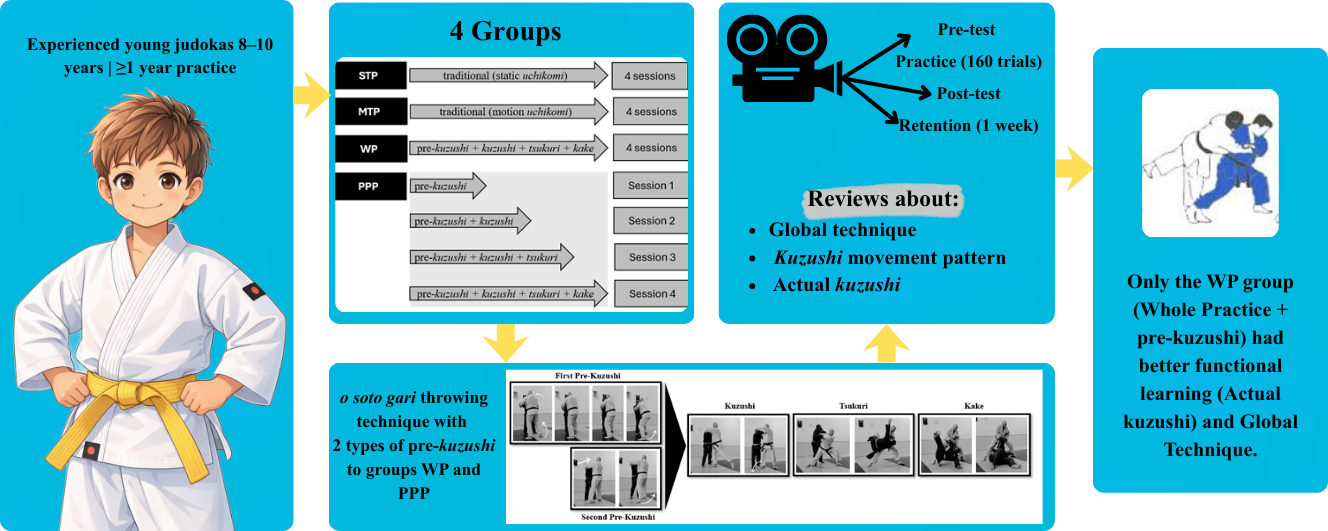
AIM: To investigate the effects of different practice schedules - static traditional, dynamic traditional, whole with kuzushi preparation, and progressive parts with kuzushi - on the acquisition of the tai otoshi technique in experienced young judokas.
METHODS:Thirty-two children (8.63±0.99 years), each with at least one year of judo training, were randomly assigned to four groups. The protocol included a pre-test, four practice sessions (160-trials), a post-test, and a retention test. Performance was evaluated via video analysis using a validated checklist assessing global technique, kuzushimovement, and actual opponent unbalancing.
RESULTS:All groups improved in global technique and kuzushi movement pattern. However, only the whole practice group showed significant gains in actual kuzushi across post-test and retention phases. Intergroup analysis demonstrated that this group outperformed the others in both global technique and opponent unbalancing, particularly in retention.
INTERPRETATION:These findings suggest that whole practice incorporating pre-kuzushi strategies promotes more effective learning than traditional or segmented approaches, even among children with prior experience. The study advances the discussion on whole versus part practice, indicating that tai otoshi, though moderately complex, benefits from high task organization and continuous execution. It also critiques traditional uchikomi, which may neglect realistic fight conditions. Integrating pre-kuzushi appears to improve timing, leverage, and opponent destabilization, key components in successful execution.
Downloads
Downloads
Published
How to Cite
Issue
Section
License
Copyright (c) 2025 Fabio R. F. Gomes, Cassio M. Meira JR, Go Tani

This work is licensed under a Creative Commons Attribution-NonCommercial-NoDerivatives 4.0 International License.
Authors must declare that the work submitted is their own and that copyright has not been breached in seeking its publication. If the manuscript includes work previously published elsewhere, it is the author(s) responsibility to obtain permission to use it and to indicate that such permission has been granted.
Authors retain the copyright of their paper and grant the Brazilian Journal of Motor Behavior (BJMB) the right to first publish the work under a Creative Commons Attribution-NonCommercial-NoDerivatives license (CC BY-NC-ND). This license allows users to share the paper given the appropriate credit to the author and source and does not allow commercial uses and derivative materials to be produced.