Validation of the Wii™ Balance Board for countermovement jump height assessment in healthy adults
DOI:
https://doi.org/10.20338/bjmb.v19i1.511Keywords:
Wii Balance Board, Reliability, Agreement, Force Platform, Countermovement JumpAbstract
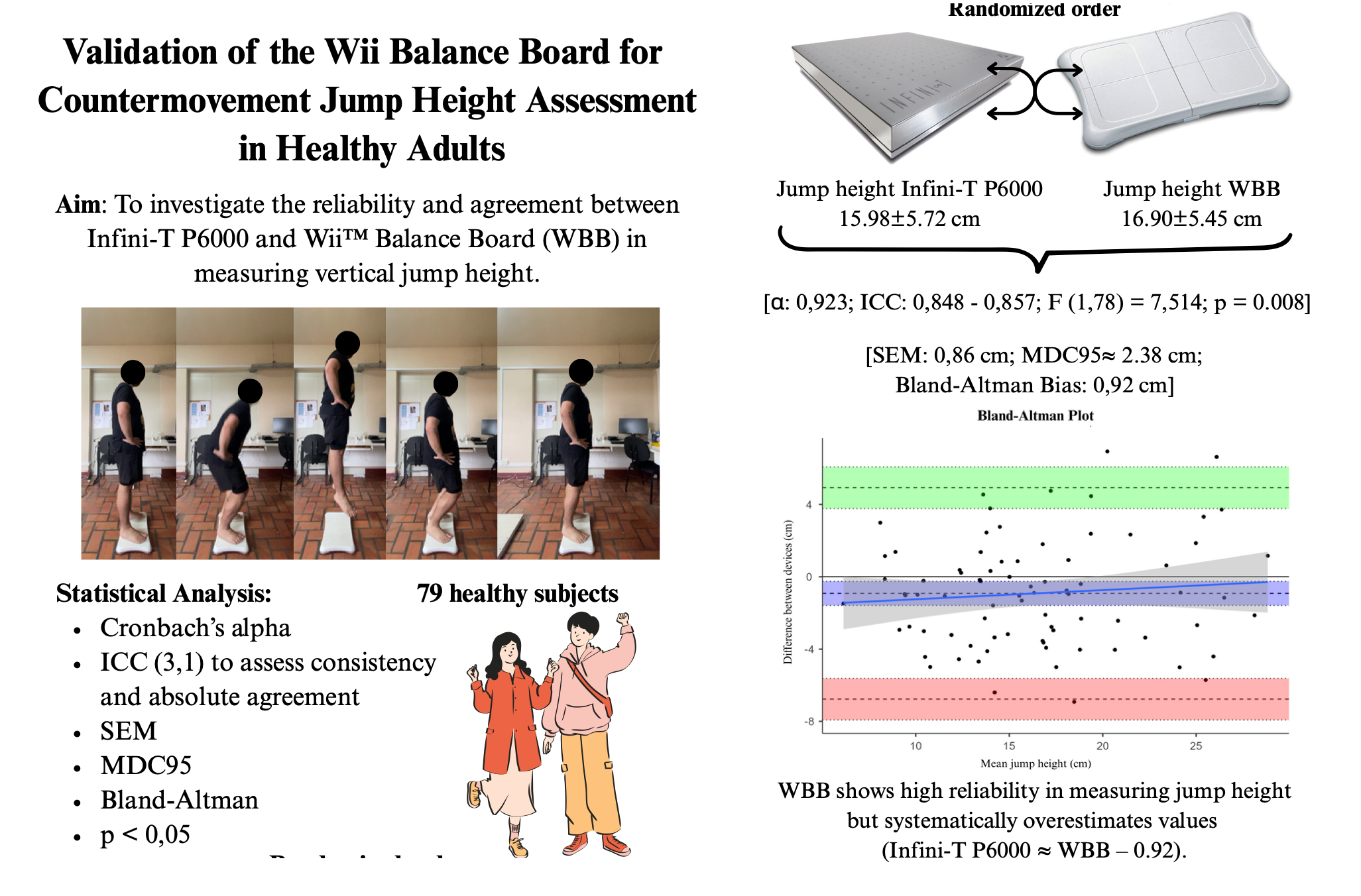
BACKGROUND: Vertical jump height assessment is essential for clinical evaluation and monitoring athletic performance. The force platform (Infini-T P6000) is considered the gold standard, whereas the Wii™ Balance Board (WBB) platform is a low-cost and more accessible alternative yet to be validated.
AIM: To investigate the reliability and agreement between Infini-T P6000 and WBB in measuring vertical jump height.
METHODS: Cross-sectional observational study. Seventy-nine participants performed countermovement jumps on both platforms, in randomized order. Cronbach's alpha was calculated to verify consistency between methods, and intraclass correlation coefficient (ICC:3.1) to verify consistency and absolute agreement, standard error of measurement (SEM), and minimum detectable change (MDC95). Systematic differences between methods were investigated during the ICC analysis using repeated-measures ANOVA (Between Items) and using Bland–Altman analysis. Statistical significance was set at p<0.05.
RESULTS: Cronbach’s alpha was 0.923, indicating excellent internal consistency. The ICC ranged from 0.848 to 0.857, confirming high reliability in both definitions. The repeated-measures ANOVA performed during the ICC test revealed significant systematic differences between the methods [F(1,78)=7.514; p=0.008], with mean jump heights of 15.98±5.72 cm (Infini-T P6000) and 16.90±5.45 cm (WBB), resulting in a systematic bias of +0.92 cm favoring WBB, confirmed by Bland–Altman analysis. SEM was 0.86 cm and MDC95≈2.38 cm.
INTERPRETATION: WBB shows high reliability in measuring jump height but systematically overestimates values compared to Infini-T P6000. Although the bias is smaller than the MDC95, it compromises direct interchangeability between methods. Standardization of the measurement device in longitudinal assessments or applying a correction offset (Infini-T P6000≈WBB–0.92) is recommended.
Downloads
Downloads
Published
How to Cite
Issue
Section
License
Copyright (c) 2025 Luiz H. C. Duarte, Larissa Sinhorim, Julya C. A. Silva, Giovanna G. Coutinho, Maria E. D. França, Iramar B. Nascimento, Gilmar M. Santos, Rilliam Schauffert

This work is licensed under a Creative Commons Attribution-NonCommercial-NoDerivatives 4.0 International License.
Authors must declare that the work submitted is their own and that copyright has not been breached in seeking its publication. If the manuscript includes work previously published elsewhere, it is the author(s) responsibility to obtain permission to use it and to indicate that such permission has been granted.
Authors retain the copyright of their paper and grant the Brazilian Journal of Motor Behavior (BJMB) the right to first publish the work under a Creative Commons Attribution-NonCommercial-NoDerivatives license (CC BY-NC-ND). This license allows users to share the paper given the appropriate credit to the author and source and does not allow commercial uses and derivative materials to be produced.