
Modularity in wearable devices: Impacts on development, usability, and maintenance – a systematic review
DOI:
https://doi.org/10.20338/bjmb.v19i1.518Keywords:
Wearables, Modularity, Development process, User experience, MaintenanceAbstract
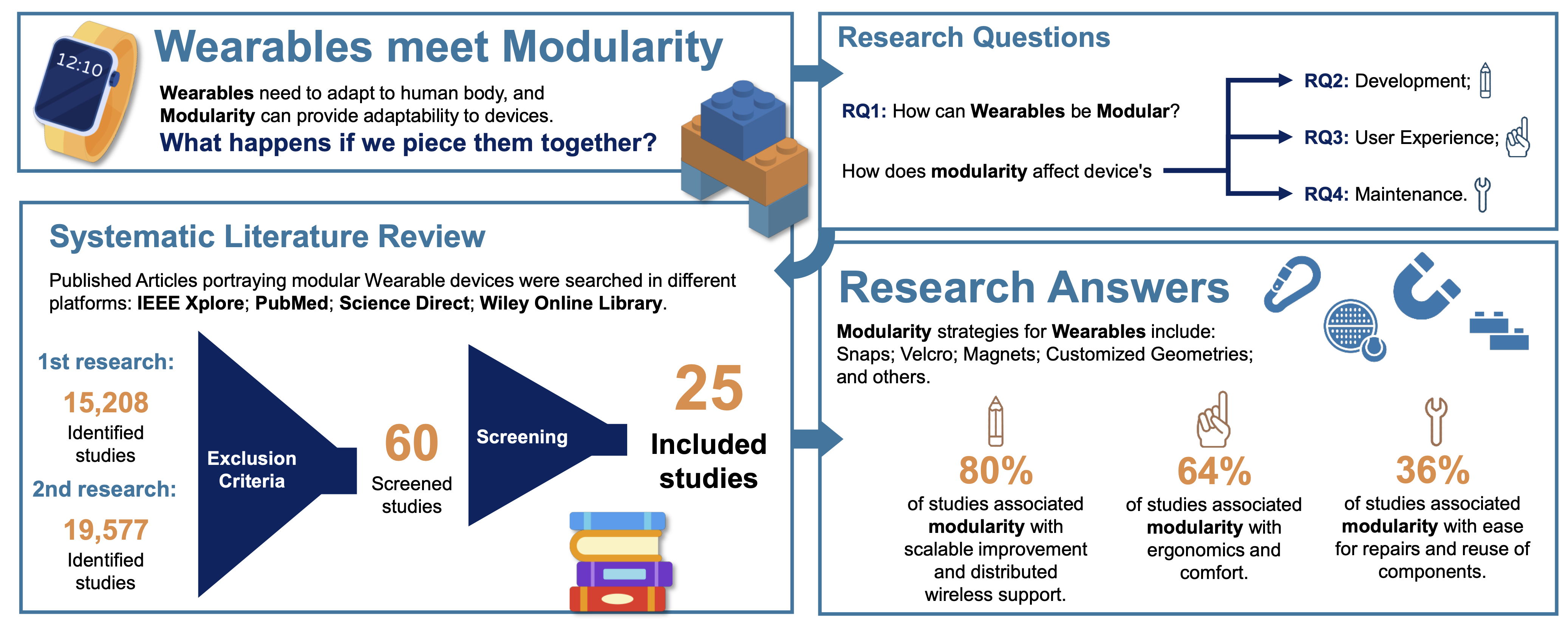
BACKGROUND: Wearable devices integrate sensors and computational systems into daily life, supporting health, sports, and rehabilitation. Modularity, defined as the division of functions into interoperable subsystems, has emerged as a strategy to enhance personalization, usability, and lifecycle management.
AIM: This systematic review examined how modular design strategies have been applied to wearable devices and evaluated their impacts on development, user experience, and maintenance.
METHOD: A structured search in PubMed, IEEE Xplore, ScienceDirect, and Wiley (2019–2025) identified 15,208 records. Following PRISMA guidelines, 25 studies met eligibility criteria, including modular hardware wearables with functional implementation. Study quality was assessed using a custom 12-item checklist.
RESULTS: Results: All studies (25/25; 100%) described attachment strategies such as snaps, hook-and-loop fasteners, magnetic couplers, or customized geometries. Modularity improved development in 80% of studies, supporting distributed architectures, wireless integration, and scalable workflows, though conversion of monolithic systems remained a challenge. Positive impacts on user experience were reported in 64% of studies, particularly through ergonomic adaptability, comfort, and configurability. Maintenance benefits were highlighted in 36% of studies, with modular systems enabling quick repairs, upgrades, and reuse of electronic and textile components. Importantly, modularity facilitated integration of neurophysiological tools (sEMG, fNIRS, EEG), enhancing sensor placement flexibility and artifact reduction in applied contexts.
INTERPRETATION: Evidence consistently supports modularity as a foundational strategy to improve adaptability, usability, and sustainability of wearable devices. While its potential for portable neurophysiological assessment is promising, further validation in sports, rehabilitation, and everyday environments is urgently needed.
Downloads
Downloads
Published
How to Cite
Issue
Section
License
Copyright (c) 2026 André C. M. Silva, Eric D. P. Santos, Kaue O. Anjos, Gabriel S. Barros, Walter T. L. Junior, Maria E. Kunkel

This work is licensed under a Creative Commons Attribution-NonCommercial-NoDerivatives 4.0 International License.
Authors must declare that the work submitted is their own and that copyright has not been breached in seeking its publication. If the manuscript includes work previously published elsewhere, it is the author(s) responsibility to obtain permission to use it and to indicate that such permission has been granted.
Authors retain the copyright of their paper and grant the Brazilian Journal of Motor Behavior (BJMB) the right to first publish the work under a Creative Commons Attribution-NonCommercial-NoDerivatives license (CC BY-NC-ND). This license allows users to share the paper given the appropriate credit to the author and source and does not allow commercial uses and derivative materials to be produced.