
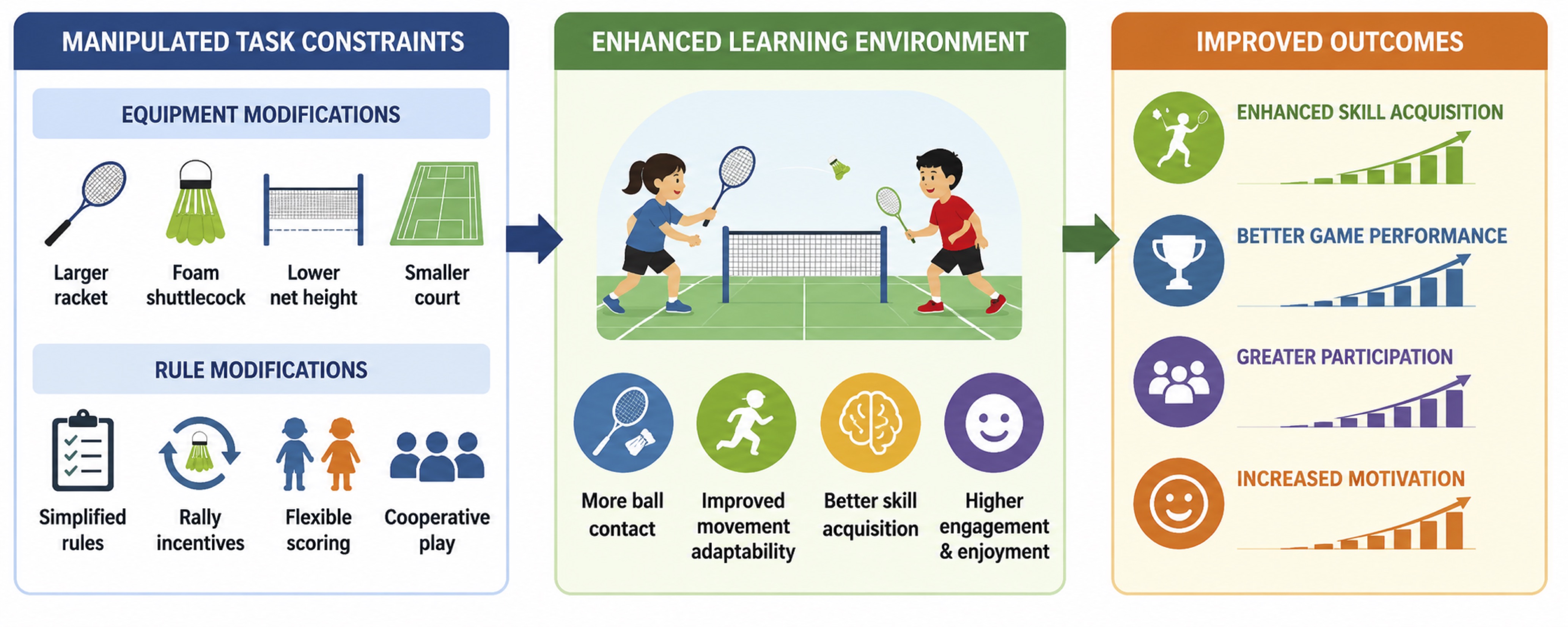
Manipulating task constraints in children’s badminton: How equipment and rule modifications shape skill acquisition and game performance
DOI:
https://doi.org/10.20338/bjmb.v20i1.532Keywords:
Body-scaling, Motor performance, Modified court, Modified rules, Task constraintsAbstract
BACKGROUND: The concepts of body-scaling, specifically pi ratios, have been developed to establish systematic guidelines for adapting junior sports.
AIM: To investigate the impact of modifying court size and game rules using a body-scaling approach on badminton performance during match-play among children.
METHODS: In a seven-week crossover training program, thirty boys (mean age = 13.17 ± 0.83 years) were exposed to both standard court and rules (SCR) and modified court and rules (MCR) conditions. Three evaluation points – the pre-test, the intermediate test, and the post-test – were used to measure performance indicators such as winning strokes, successful strokes, and unforced errors.
RESULTS: Successful strokes (F(2,58) = 10.412, p <.05, η² =.488), winning strokes (F(2,58) = 12.865, p < .001, η2 = .556), and unforced errors (F(2, 8) = 8.231, p < .05, η2 = .487) all showed significant interaction effects, according to a two-way repeated measures ANOVA. Under the MCR condition, the following main effects also improved more: winning strokes (F(1,29) = 42.947, p < .005, η2 = .748), successful strokes (F(1,29) = 71.583, p < .001, η2 = .902), and less unforced errors (F(1,29) = 33.114, p < .001, η2 = .695).
INTERPRETATION: These findings imply that task constraints based on children's physical attributes greatly improve technical skills and overall game performance in badminton performance. The body-scaling strategy provides a practical way to promote more effective performance and stroke execution in junior badminton by increasing stroke effectiveness and reducing unforced errors during match play.
Downloads
Downloads
Published
How to Cite
Issue
Section
License
Copyright (c) 2026 Mohd R. W. N. Wazir, Pathmanathan K. Suppiah, MD Safwan Samsir, Frederick J. F. Mojilon, Zuliana Bacho, Hon K. Yee, Abdul M. N. Azmi, Amin Akbar

This work is licensed under a Creative Commons Attribution-NonCommercial-NoDerivatives 4.0 International License.
Authors must declare that the work submitted is their own and that copyright has not been breached in seeking its publication. If the manuscript includes work previously published elsewhere, it is the author(s) responsibility to obtain permission to use it and to indicate that such permission has been granted.
Authors retain the copyright of their paper and grant the Brazilian Journal of Motor Behavior (BJMB) the right to first publish the work under a Creative Commons Attribution-NonCommercial-NoDerivatives license (CC BY-NC-ND). This license allows users to share the paper given the appropriate credit to the author and source and does not allow commercial uses and derivative materials to be produced.