Feasibility and preliminary effects of group modified constraint-induced movement therapy in Chronic Stroke: A pilot study
DOI:
https://doi.org/10.20338/bjmb.v19i1.509Keywords:
Stroke rehabilitation, Occupational therapy, Physical therapy, Restriction-induced movement therapy, Upper limb, Group therapyAbstract
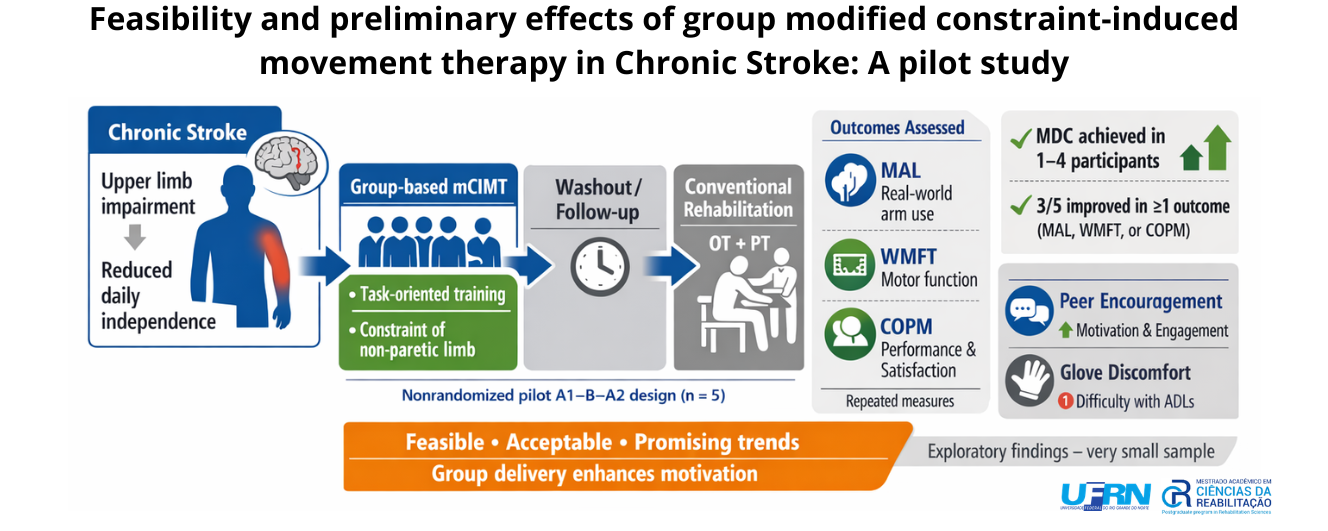
BACKGROUND:Upper limb impairment after stroke significantly limits independence in daily life. Modified constraint-induced movement therapy (mCIMT) is effective for improving paretic upper limb use, and group-based delivery may enhance feasibility, motivation, and scalability in clinical settings.
AIM:To examine the feasibility and preliminary clinical effects of group-based mCIMT compared with conventional rehabilitation in individuals with chronic stroke, and to explore therapist and patient perceptions of the group format.
METHODS:A nonrandomized pilot quasi-experimental repeated-measures design (A1–B–A2) was conducted with five individuals with chronic stroke. Participants underwent group-based mCIMT, followed by a washout/follow-up period (B), and then conventional rehabilitation. Outcomes included the Motor Activity Log (MAL), Wolf Motor Function Test (WMFT), and Canadian Occupational Performance Measure (COPM). Qualitative feedback was collected through open-ended interviews with patients and therapists.
RESULTS:Individual responses varied across outcomes, with minimal detectable change attainment observed in 1-to-4 participants depending on the measure and phase. Three out of five participants achieved minimal detectable change thresholds for at least one MAL, WMFT, or COPM outcome. Therapists described enhanced motivation, peer support, and engagement during group sessions. Three patients reported facilitators such as peer encouragement and structured guidance, as well as barriers including glove discomfort and challenges with some ADLs.
INTERPRETATION:Group-based mCIMT was feasible, acceptable, and associated with promising trends in upper limb use and perceived performance. However, the findings remain exploratory given the very small sample size, the absence of randomization, and the fixed intervention order. Larger randomized controlled studies are needed to evaluate the clinical impact of group-delivered mCIMT.
Downloads
Downloads
Published
How to Cite
Issue
Section
License
Copyright (c) 2025 Fábio R. O. Galvão, Maria C. A. Silvestre, Camila L. A. Gomes, Nayara K. F. P. Tatsch, Ana L. S. Medeiros, Clebeson A. Nogueira, Denise S. Araújo, Emanuel S. M. Dantas, Enio W. A. Cacho, Roberta O. Cacho

This work is licensed under a Creative Commons Attribution-NonCommercial-NoDerivatives 4.0 International License.
Authors must declare that the work submitted is their own and that copyright has not been breached in seeking its publication. If the manuscript includes work previously published elsewhere, it is the author(s) responsibility to obtain permission to use it and to indicate that such permission has been granted.
Authors retain the copyright of their paper and grant the Brazilian Journal of Motor Behavior (BJMB) the right to first publish the work under a Creative Commons Attribution-NonCommercial-NoDerivatives license (CC BY-NC-ND). This license allows users to share the paper given the appropriate credit to the author and source and does not allow commercial uses and derivative materials to be produced.